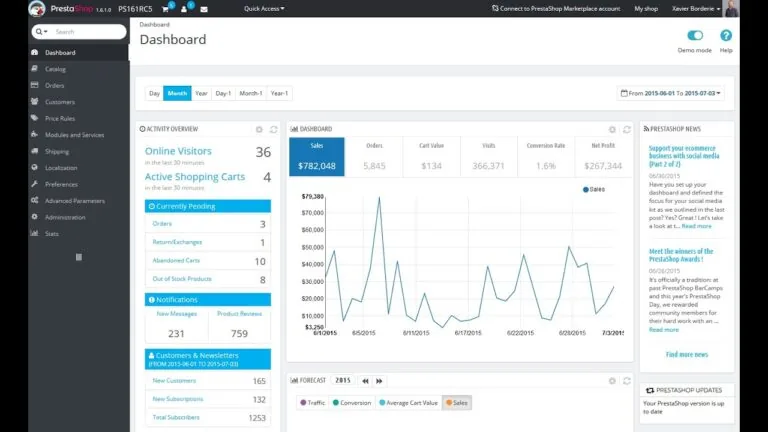
The PrestaShop or WooCommerce question appears in almost every Greek e-shop project. The wrong answer is to choose whatever looks cheaper at launch. The right answer is to look at the business model, catalog size, pricing complexity and the people who will operate the store every day.
Both platforms are mature and open source. WooCommerce lives inside WordPress and fits very well when the store is part of a broader content, service and SEO website. PrestaShop is more purely e-commerce oriented and often fits better when the business has a larger catalog, complex product attributes, many categories, pricing rules, B2B needs or a more structured commercial workflow.
When WooCommerce makes sense
WooCommerce is a strong choice for small and medium Greek e-shops that also need content. If a business sells products but also needs blog articles, guides, SEO pages, local service pages and landing pages, WordPress is a major advantage.
It is also practical when the team already knows WordPress. Content editing is easy, the SEO and marketing ecosystem is broad, and many developers can support it. With good hosting, a clean theme and controlled plugins, WooCommerce can work very well for stores with hundreds or a few thousand products.
The risk is overload. Many WooCommerce sites become slow because they accumulate builders, popups, tracking scripts, filters, unnecessary plugins and weak hosting. WooCommerce recommends PHP 8.3+, MySQL 8.0 or MariaDB 10.6+ and a WordPress memory limit of at least 256 MB. For a real store, that should be treated as a baseline.
When PrestaShop makes sense
PrestaShop makes sense when the e-shop is the core of the business, not an add-on to a company site. If there are many combinations, advanced filters, special prices, discount rules, customer groups, multiple stores or heavier catalog operations, PrestaShop often feels more directly e-commerce focused.
The official PrestaShop 9 system requirements point to a modern stack, at least MySQL 5.7 or MariaDB 10.2 and a recommended PHP memory limit of 512 MB per script. That is a practical signal: PrestaShop should not be placed on weak shared hosting just because it is open source. It needs proper infrastructure as the store grows.
In Greece, PrestaShop is often selected by stores that need structured product management, marketplace feeds, couriers, ERP, invoicing, stock and commercial rules. It is not always cheaper at the start, but it can be cleaner operationally when the business is e-commerce first.
The Greek reality
In Greece, the platform is not judged only by the admin panel. It is judged by payments, cash on delivery, Viva/Stripe/bank flows, invoicing, myDATA or ERP, courier vouchers, XML feeds, stock, VAT, B2B prices and Greek order emails. These are the things that break e-shops, not the platform logo.
For a small store with 100 products, strong content needs and SEO articles, WooCommerce is usually more flexible. For a store with 10,000 products, filters, different prices and daily commercial operations, PrestaShop deserves serious consideration. For very large projects, the decision becomes architectural: hosting, cache, database, ERP and team processes.
Cost and maintenance
WooCommerce can start cheaper when a WordPress site already exists. But if the site fills up with premium plugins and custom fixes, maintenance cost rises. PrestaShop may need a more specialized developer, so support can cost more, but e-commerce workflows may stay cleaner.
The right choice is not the lowest initial build price. It is the platform with the lowest total cost of ownership over the next three years, including speed, updates, integrations, security, staff time and change requests.
How to make the decision
For a Greek e-shop that relies heavily on content, services, blog and marketing, WooCommerce is often the more practical choice. For a store that is primarily a commercial engine with a large catalog, rules, stock and demanding product management, PrestaShop may be the stronger base.
The final decision should come from requirements, not habit. How many products do you have? Who manages them? What integrations do you need? How fast must the store be? What maintenance budget exists? Once these are answered, the platform decision becomes much clearer.