Anthropic introduced Claude Opus 4.8 on May 28, 2026. This is not just another version number. It is the kind of release that shows where the market is going: less “write me a quick paragraph” and more “take a complex task, split it properly, use tools, and tell me where the risk is.”
That is what matters for developers, technical teams and businesses. The new Opus does not promise magic. It points to better judgment, better tool use, stronger long-context handling and more mature behavior in agentic workflows. In plain terms: less demo noise, more chance of getting real work done.
What Claude Opus 4.8 is, in simple terms
Claude Opus 4.8 is Anthropic’s new flagship model for difficult work: complex analysis, professional workflows, large codebases and tasks where AI has to use tools, keep context and stay on track through many steps. The official API model ID is claude-opus-4-8.
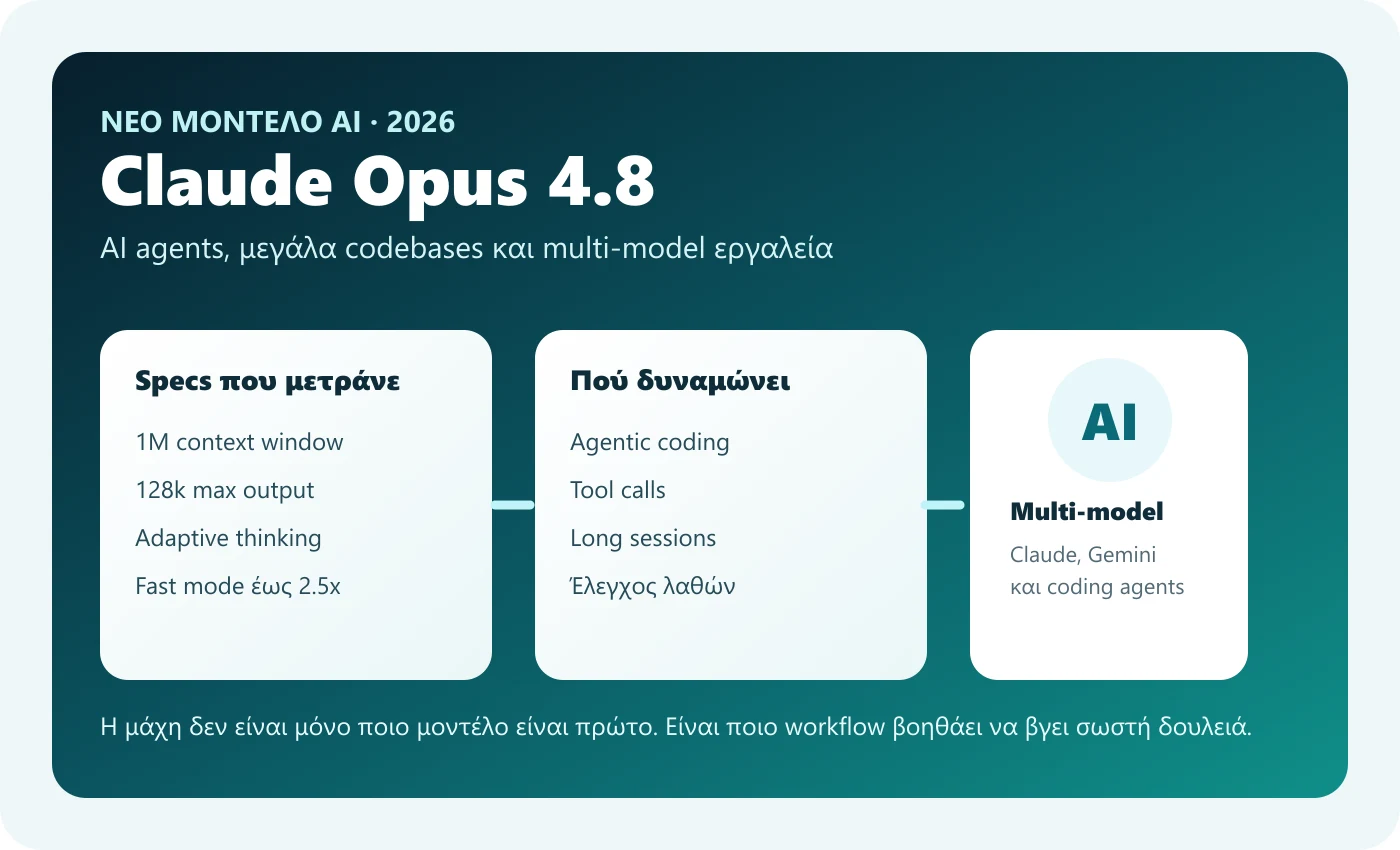
The practical specifications are clear: a 1M token context window on the Claude API, Amazon Bedrock and Vertex AI, 128k max output tokens on the synchronous Messages API, adaptive thinking, text and image input, text output, multilingual and vision capabilities. On Microsoft Foundry, Anthropic lists 200k context. For a team working with large files, reports or code, context is not a small detail. It is the room the model has to understand the work.
The key change is not only raw power
Anthropic’s announcement gives weight to something that often gets treated as secondary: model honesty. The company says Opus 4.8 is around four times less likely than Opus 4.7 to leave flaws in code it has written without flagging them. That sounds less flashy than a benchmark, but in real development it is one of the most important points.
Anyone who has used AI coding tools knows the problem. A model can write something that looks right, speak with confidence and still leave behind a hidden bug, a bad assumption or a change that breaks another part of the system. If a model more often says “this needs a test”, “I am not sure here” or “this plan is not sound”, it becomes a better collaborator, not just a faster generator.
Measurements and features worth watching
In the official docs, Anthropic points to improvements in long-horizon agentic coding, better long-context handling, better recovery after compaction and fewer cases where the model skips a tool call that the task required. These sound technical, but they translate simply: when an AI works for a long time, across many steps and many tools, it is less likely to lose the thread.
There is also fast mode in research preview on the Claude API, with up to 2.5x higher output tokens per second. Anthropic lists pricing at $5 per 1M input tokens and $25 per 1M output tokens for regular usage. For fast mode, it lists $10 per 1M input tokens and $50 per 1M output tokens. This is not a cheap model for every prompt. It is a model for tasks where quality, context and reliability are worth more than the lowest possible cost.
Another useful API feature is mid-conversation system messages. Developers can append updated instructions during a long-running conversation without rebuilding the whole prompt and without wasting prompt cache. For a simple chat, this may not sound exciting. For agents that run for a long time, change permissions, receive updated environment context or follow a budget, it matters.
Dynamic workflows show where this is heading
Alongside Opus 4.8, Anthropic introduced dynamic workflows in Claude Code. The idea is that a large project should not be treated like one huge prompt. The tool can plan the work, split it into subtasks, run many parallel subagents and then verify the results before reporting back.
That is closer to how a real technical team works. Someone maps the system, someone looks at tests, someone changes the UI, someone searches for edge cases. AI does not suddenly become a senior team on its own, but the workflow starts looking more like organized engineering work and less like a single chat window answering one turn at a time.
For a large code migration, a multi-file refactor or an audit that needs routes, tests, sitemap and frontend checks, writing code is not enough. The model has to keep a plan, understand consequences and avoid confusing the last change with the first one. That is why long-horizon work is central to this release.
Where Google Antigravity fits
Google Antigravity enters the discussion from another direction. Google described it as an agent-first development platform, an environment where agents can access the editor, terminal and browser, create a plan, write code and validate work. It is not just autocomplete. It is an attempt to move development from “write this function” to “handle this technical task with verification.”
The important point is the multi-model workflow. Official Antigravity docs list reasoning model options such as Gemini, previous Claude Sonnet/Opus versions and GPT-OSS. That does not mean Antigravity has confirmed Claude Opus 4.8 support today. We should not claim that unless the docs say it. What it does show is the larger direction: development tools will not be judged only by which model they include, but by how they choose models, control actions and keep the workflow safe.
This connects with our previous articles on AI agents, n8n and MCP and Gemini 3.5 Flash and the next generation of AI agents. The conclusion is the same: the future is not one model doing everything. It is workflows with models, tools, permissions, logs, validation and human responsibility.
What this means for businesses and developers
For a business, Opus 4.8 is not a reason to throw away every existing tool and chase the newest model blindly. It is a reason to review which tasks were previously too expensive or too difficult for AI: technical audits, large specifications, legal or accounting documents with human review, migration plans, documentation, code review, log analysis and structured research.
For developers, the change is more direct. A model with large context, better judgment and more reliable tool calls can help in a real codebase, not only in small snippets. It can read more, propose a better plan and keep track of work with many steps. This does not remove tests, review or human oversight. It makes them more important, because the more an agent can do, the more serious the control framework must be.
Where caution is needed
The new Opus is powerful, but it is not a license to let AI touch production without limits. Agentic tools need sandboxes, backups, permissions, logs and clear stop points. They also need a person who understands what they are approving. A mistake in an article is easy to fix. A mistake in billing, database migration or security configuration can cost much more.
Benchmarks are not the whole story either. A model can score well and still be a poor fit for your workflow, stack or budget. The right question is not “what is the best model overall?” The right question is “which model, in which tool, under which controls, for which job?”
The practical picture
Claude Opus 4.8 shows that Anthropic is pushing hard toward serious agentic workflows. Large context, stronger behavior on long-running tasks, dynamic workflows in Claude Code, more emphasis on honesty and API features that support real agents. This is not just a smarter chat surface. It is a step toward AI tools that work inside a process.
Google Antigravity shows the other side of the same market: agent-first development environments, browser/terminal/editor inside the workflow and model choice based on task. Put together, the direction is clear: AI companies are not only selling models. They are selling a way of working.
For Greek businesses, the message is simple: do not see AI only as a text generator. See it as a technical collaborator that can help with review, automation, support, development and knowledge work, as long as it is placed in the right architecture. iChipHost can help design these workflows, from AI automation to web applications, hosting and technical SEO. For a project review, start from the contact form.